Om, Mantra and Japa: How to Chant with a 108-Bead Mala
Mantra is one of the oldest meditation techniques in the world. Here is what Om means, why malas have 108 beads, and exactly how to use one.
Mantra is one of the oldest meditation techniques in the world. Here is what Om means, why malas have 108 beads, and exactly how to use one.
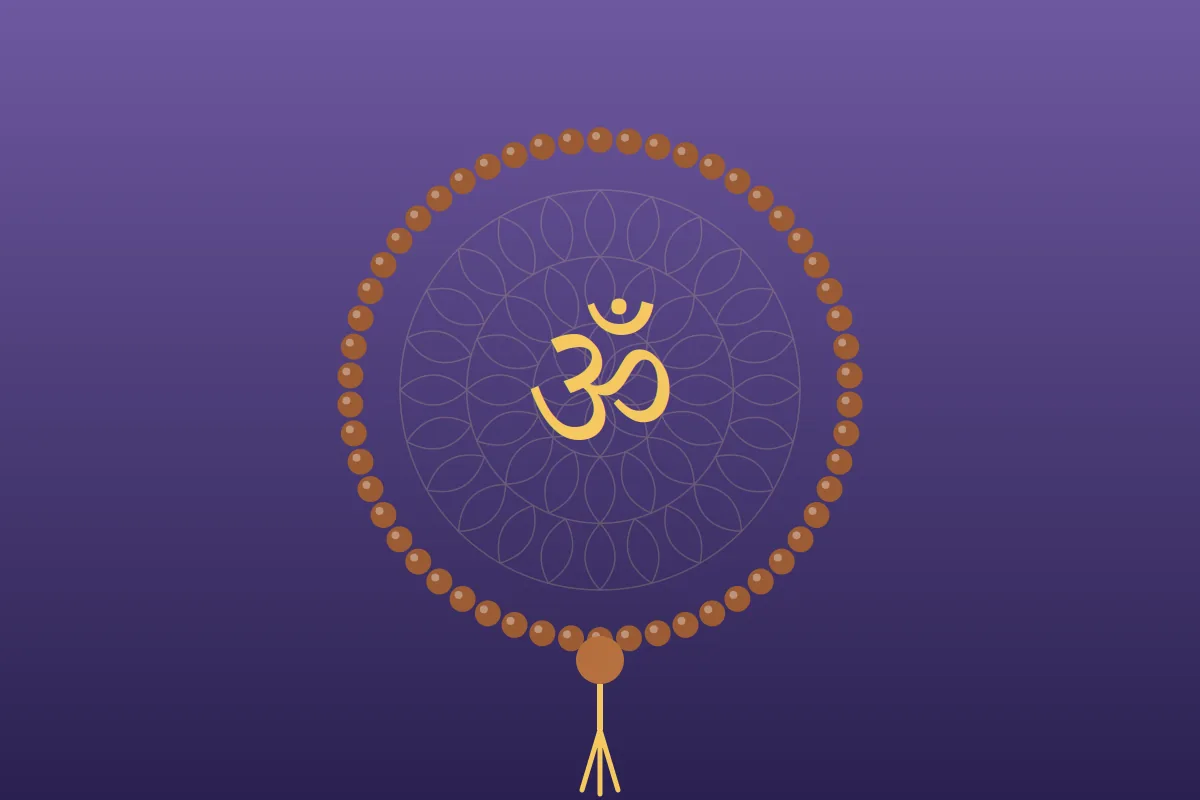
Japa is the repetition of a mantra, usually counted on a mala of 108 beads plus a larger guru bead. Hold the mala in the right hand, rest it on the middle finger and move one bead towards you with the thumb for each repetition, starting next to the guru bead. After 108 repetitions, turn the mala around rather than crossing the guru bead. Om - the primordial sound, made of A-U-M and silence - is the simplest mantra to begin with.
A mantra is a sacred syllable, word or verse used as a focus for the mind. A traditional explanation of the word divides it into manas (mind) and trana (protection or liberation) - "that which protects the mind". Japa is the practice of repeating a mantra, often a fixed number of times.
Mantra is central to many Indian traditions - Vedic, Hindu, Buddhist, Jain and Sikh - and appears throughout yoga. Patanjali says Om is the sound that expresses Ishvara and that its repetition, with reflection on its meaning, removes obstacles to meditation (Yoga Sutras 1.27-1.29).
Om (also written Aum, and ॐ in Devanagari) is regarded as the primordial sound. The short Mandukya Upanishad - just twelve verses - explains it as having four parts:
When you chant Om slowly, you move through these sounds from the back of the throat (A), through the mouth (U), to closed lips (M), and then into silence. That silence is considered as important as the sound.
The number 108 is considered sacred across Hindu, Buddhist and Jain traditions, and there is no single reason for it. Commonly given explanations include the 108 Upanishads in the Muktika canon, 12 zodiac signs multiplied by 9 planets (navagraha), 27 lunar mansions (nakshatras) multiplied by 4 quarters, and 108 names of many deities (the ashtottara shatanamavali). Whatever the reason, 108 repetitions takes roughly ten to fifteen minutes - a natural meditation session.
A full mala has 108 counting beads plus one larger bead called the guru or sumeru bead, which marks the start and end. Common materials include rudraksha seeds (associated with Shiva), tulsi wood (associated with Vishnu and Krishna), sandalwood and crystal.
If a bead slips or you lose count, do not worry - carry on. Attention to the mantra is more important than an exact count.
Traditional texts describe three levels of japa:
A good approach is to start aloud, move to a whisper, and finish silently in the same session.
If you belong to a particular tradition, a mantra from that tradition - or one given by your teacher - is the natural choice. If you do not, Om or So Ham are complete practices on their own.
Try one mala (108 repetitions) each morning for 40 days - a traditional period for establishing a practice (a mandala of days). Keep your mala in a clean cloth or pouch, and use it only for japa. Combine it with the breath-based practice in our beginner's meditation guide.
108 is a sacred number in Hindu, Buddhist and Jain traditions. Common explanations include the 108 Upanishads, 12 zodiac signs times 9 planets, and 27 lunar mansions times 4. A round of 108 also makes a convenient meditation session.
The guru (sumeru) bead represents the teacher or the summit of practice. Tradition asks you to turn the mala around at the guru bead as a sign of respect rather than passing over it.
Yes. Om is considered a universal sound and is widely practised by people of all backgrounds. Some specific mantras, such as the Gayatri, are traditionally received from a teacher.
Traditional texts rank mental japa as the most subtle, but beginners often find chanting aloud easier to stay with. Many practitioners move from aloud to whispered to silent within one session.
Health note: This article is for education only and is not a substitute for professional medical advice. Consult a qualified doctor or Ayurvedic practitioner before starting new practices, especially if you are pregnant, have a medical condition or take medication. Read our full disclaimer.
Learn how to meditate in 10 minutes a day: posture, breath-counting, handling a busy mind, and a simple 30-day plan rooted in the yogic practice of dhyana.
5 min read
What is karma yoga? The Bhagavad Gita's teaching on selfless action explained through key verses (2.47, 2.48, 2.50, 3.19) and practical ways to apply it at work and home.
4 min read
What are Vata, Pitta and Kapha? A clear guide to the three Ayurvedic doshas, their qualities, signs of imbalance and simple ways to rebalance each one.
5 min read
New articles on Ayurveda, yoga and spirituality, plus one seasonal practice. No spam; unsubscribe anytime.