How to Start Meditating: A Practical Beginner's Guide (Dhyana)
You do not need an empty mind, a mountain or an hour a day. You need a place to sit, a simple anchor, and the willingness to begin again every time you wander.
You do not need an empty mind, a mountain or an hour a day. You need a place to sit, a simple anchor, and the willingness to begin again every time you wander.
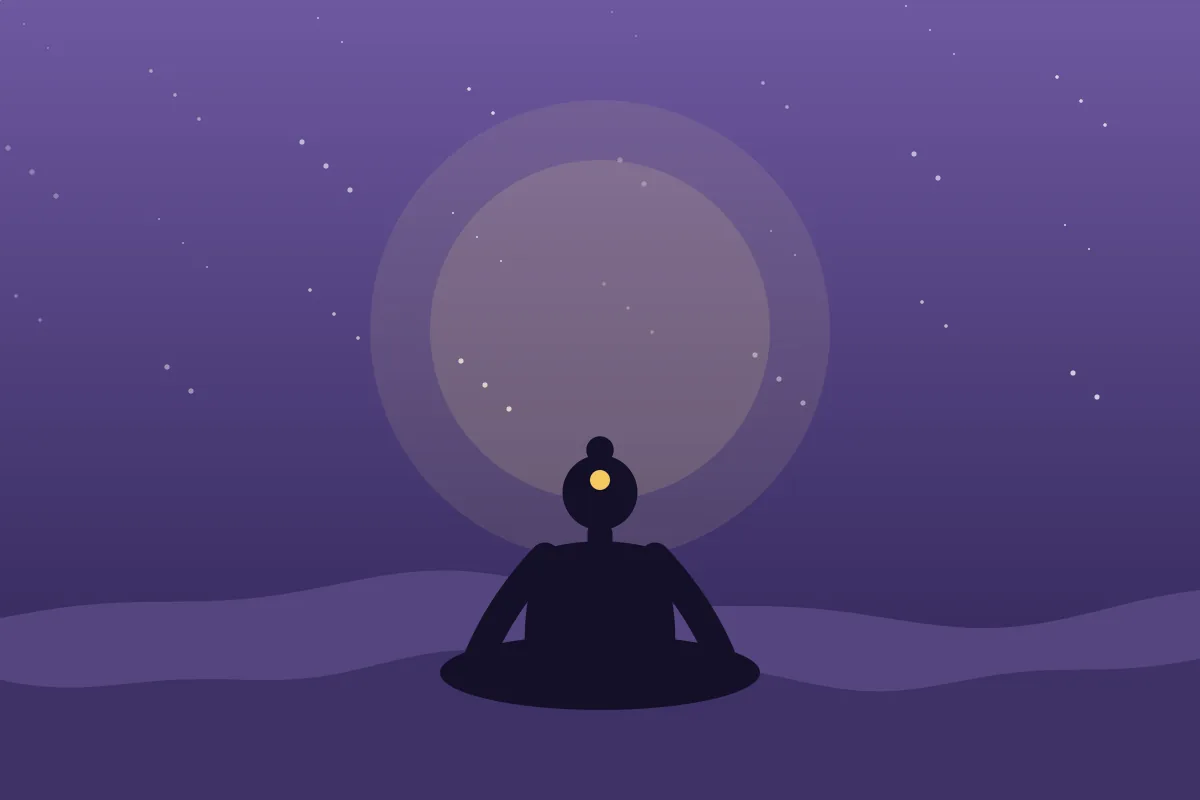
To start meditating, sit upright in a quiet place, set a timer for 5-10 minutes, close your eyes and rest your attention on the breath - for example by silently counting each exhalation from one to ten. Whenever you notice your mind has wandered, gently return to the breath. That act of returning is the practice. Meditate at the same time every day.
In the yogic tradition, meditation is called dhyana, the seventh of the eight limbs of yoga. Patanjali describes it as an unbroken flow of attention towards one object (Yoga Sutra 3.2). The Bhagavad Gita's sixth chapter, Dhyana Yoga, gives similar advice: sit in a clean place, on a seat neither too high nor too low, holding the body, head and neck erect and still (6.11-13).
Meditation is not emptying the mind, stopping thoughts by force, or reaching a special state on day one. It is training attention - and like any training, it works through repetition.
Pick a time you can keep every day. Early morning, after washing and before checking your phone, is traditional; the brahma muhurta before sunrise is considered ideal. Evening before dinner works well too. Use the same spot each day - a corner with a cushion or chair is enough.
The aim is Patanjali's sthira sukham - steady and comfortable. If you are in pain, change position; discomfort is a distraction, not a virtue.
Take three slow, deep breaths, letting each exhalation be a little longer than the inhalation. Then let the breath return to its natural rhythm. A minute of Nadi Shodhana beforehand is an excellent way to settle.
Choose one anchor for your attention:
It will wander - within seconds, at first. You will find yourself planning dinner, replaying a conversation or composing an email. This is not failure. The moment you notice is a moment of awareness. Gently label it ("thinking"), let it go, and return to the anchor.
The Gita acknowledges this directly. When Arjuna protests that the mind is as hard to control as the wind, Krishna agrees - and says it can be trained through practice (abhyasa) and detachment (vairagya) (6.34-35). Every return is one repetition of that practice.
When the timer sounds, sit for a few more breaths. Notice how you feel without judging it. Open the eyes slowly. Some people like to end with a moment of gratitude or a short prayer.
"I can't stop thinking." You are not supposed to. Meditation changes your relationship to thoughts, not their existence.
"I fall asleep." Sit more upright, meditate earlier in the day, or keep the eyes half-open.
"I don't have time." Five minutes counts. So does two. Attach it to an existing habit, such as after brushing your teeth.
"Nothing is happening." Benefits are often noticed in daily life - a slightly longer pause before reacting - rather than during the session.
Restlessness or strong emotions. These can arise. Open your eyes, feel your feet on the floor, and breathe. If meditation regularly brings up distressing experiences, talk to a qualified teacher or mental-health professional.
Keep a one-line journal: date, minutes, and one word for how it felt. The streak itself is motivating.
According to the US National Center for Complementary and Integrative Health (NCCIH), studies suggest meditation and mindfulness practices may help with anxiety, depression, stress, blood pressure and insomnia, though the quality of evidence varies. Meditation is generally safe for healthy people, but it should not replace conventional treatment for any medical or psychological condition.
Five to ten minutes a day is ideal to begin. Regular short sessions build the habit and the skill more effectively than occasional long ones.
Early morning is traditional, especially before sunrise, because the mind is fresh and the house is quiet. Any time you can keep consistently is good.
Yes. A wandering mind is universal. Noticing the wandering and gently returning to your anchor is the actual exercise of meditation.
You can start safely on your own with simple breath-based practice. A qualified teacher becomes valuable as you go deeper, or if you have questions or difficult experiences.
Health note: This article is for education only and is not a substitute for professional medical advice. Consult a qualified doctor or Ayurvedic practitioner before starting new practices, especially if you are pregnant, have a medical condition or take medication. Read our full disclaimer.
What Om means, why a mala has 108 beads, and how to practise mantra japa step by step - aloud, whispered or silent - with beginner-friendly mantras.
5 min read
What is karma yoga? The Bhagavad Gita's teaching on selfless action explained through key verses (2.47, 2.48, 2.50, 3.19) and practical ways to apply it at work and home.
4 min read
What are Vata, Pitta and Kapha? A clear guide to the three Ayurvedic doshas, their qualities, signs of imbalance and simple ways to rebalance each one.
5 min read
New articles on Ayurveda, yoga and spirituality, plus one seasonal practice. No spam; unsubscribe anytime.